
AI agents
Software that reads an email, decides what it is, pulls what it needs from your systems and completes the task — handing off to a person when it isn't sure.
Replaces: the inbox someone triages every morning.
AI engineering studio · India & UAE
Then we keep it running. Not a deck, not a pilot — systems in production, with logs, uptime and someone to call.
Typical first reply: within one working day.
What we build
Most agencies list technologies. Here is what you actually get, and what it changes on a Monday morning.
Software that reads an email, decides what it is, pulls what it needs from your systems and completes the task — handing off to a person when it isn't sure.
Replaces: the inbox someone triages every morning.
We train models on your history — your customers, your defects, your seasonality. Fine-tuned language models where language is the problem, classical ML where it isn't.
You get: the weights, the training code, the evaluation set.
Getting data out of portals, scans, spreadsheets and legacy systems, cleaning it, checking it, and landing it somewhere trustworthy — on a schedule, with alerts when it breaks.
Ends: "which spreadsheet is the real one?"
Provisioning, deployment and the unglamorous parts: TLS, reverse proxy, process management, backups, staging, monitoring. Set up properly once so it doesn't need heroics later.
Runs on: your account, your billing, your control.
The repetitive path between your tools — CRM to invoice, form to WhatsApp, sheet to ledger — turned into something that runs itself and tells you when it didn't.
Best first project. Fastest payback.
Client portals, admin panels, internal tools and public sites. Fast, accessible, and built so a non-developer can update the content without calling us.
Includes: the admin side, not just the pretty side.
One number everyone agrees on, refreshed automatically, delivered where your team already reads — not parked in a dashboard nobody opens.
Answers: what changed this week, and why.
A short, honest audit: where AI will pay for itself in your operation, where it won't, and what to build first. Often the most useful thing we sell.
Deliverable: a costed, sequenced plan you can act on.
Data pipelines · worked examples
Three real patterns from work we've done. Pick a domain, then click any stage to see what happens there and the code that does it.
Custom model training · live demo
This is a real neural network — two layers, trained by gradient descent in your browser, no server involved. Change the data or the architecture and watch the decision boundary move. It is the same loop we run on your data, several orders of magnitude larger.
Cloud & automation
Move the sliders to match your situation. We've assumed only 70% of the work is genuinely automatable — the rest still needs a person, and any calculator that says otherwise is selling you something.
An estimate, not a quote. It ignores the second-order win, which is usually bigger: the work stops depending on one person remembering how it's done.
Selected work
Real deployments with real users. Where a client's work is confidential, we describe the shape of the problem rather than name them.
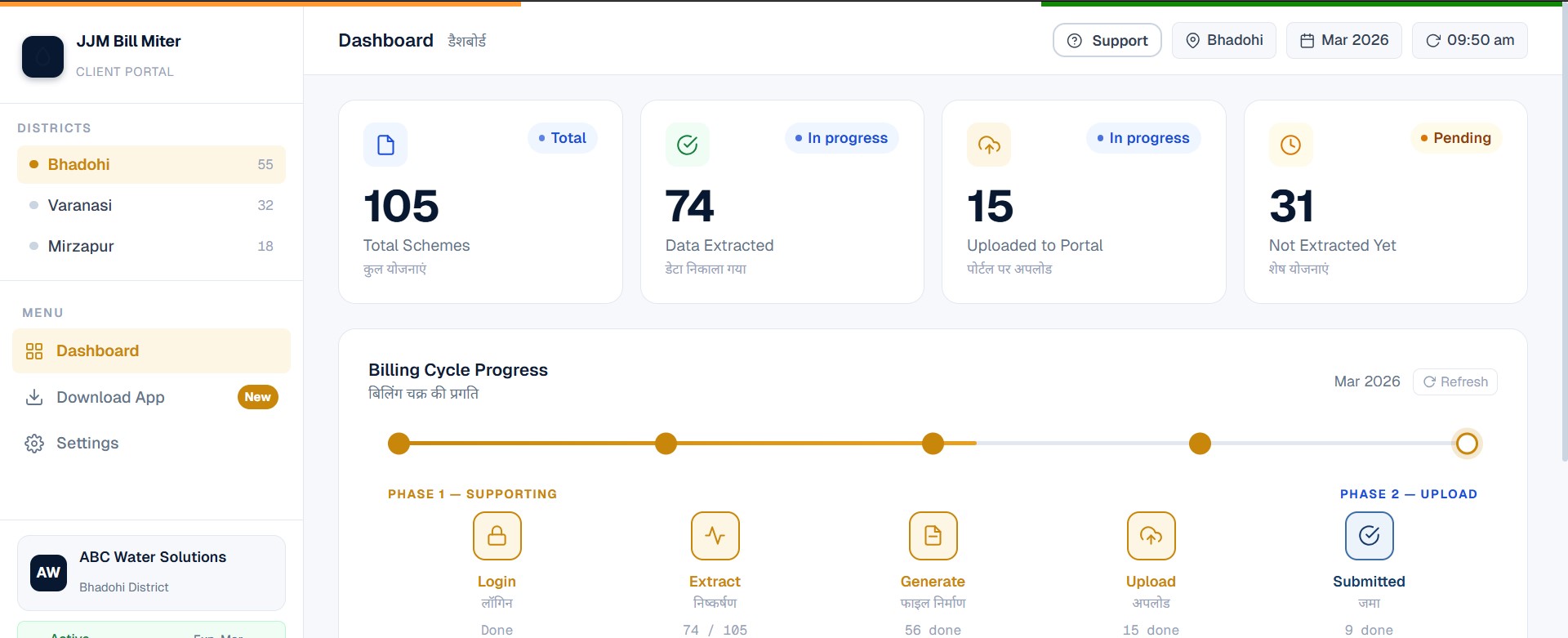
The monthly operations-and-maintenance billing cycle for a government water mission used to take two to three weeks of manual extraction, calculation and document preparation across dozens of schemes. JJM Bill Miter pulls the data from the portal, applies the tariff and penalty rules, and generates the PI, Supply, Pressure and Chlorination documents in departmental format — in under four hours, with a full audit trail from every bill back to the reading that produced it.

Public site plus a private admin panel for a premium construction firm: projects and enquiries are managed in-house, leads are tracked from first visit to conversion, and buyers can shortlist properties across sessions without creating an account.

A corporate site for a Dubai fit-out and contracting firm established in 2007, deployed on their own cloud server with TLS, process management and automated certificate renewal — so the site stays up without anyone thinking about it.

Scheduling, intake and reporting for small clinics and single-speciality practices — with no-show prediction built in, so overbooking is a decision based on your own history rather than a guess.

Progress tracking, material reconciliation and cost-overrun alerts for construction sites — built out of what we learned running software for contractors in two countries.

Our own operations stack: clients log in to see project status, agreements, invoices and deliverables, generated as PDFs on demand. Built the same way we build for clients — because we use it every day.
How a project runs
This is a real sequence, so it is numbered. Most projects follow it; larger ones repeat the middle two.
A call, then a walkthrough of the actual process — the spreadsheets, the copy-paste, the person who knows the exception. We come back with what's worth automating and what isn't.
A written scope with a number against it, the stack we'll use and what "done" means. No hourly billing, no scope drift dressed up as discovery.
Weekly working demos, not status reports. You catch a wrong assumption in week two instead of week ten. 50% on start, 50% on delivery.
Code, credentials and documentation transfer to you. We stay on for monitoring and changes if you want us to — and you can leave whenever, with everything working.
Built with
Tools we build with. Not clients, not partners.
Start here
You don't need a spec. A description of the process that's costing you time is enough to have a useful first conversation.